
THE VENDOR TRAP: How Online Food Platforms Are Hurting Local Businesses and What We Can Do About It

THE VENDOR TRAP: How Online Food Platforms Are
Hurting Local Businesses and What We Can Do About It
Prologue: The Heart of Every Celebration – A Story of
Trust and Emotion
Every celebration has a heart, and at its core lies the
special product that makes the occasion complete. For many decades, India’s
festivals and happy moments depended on our local bakeries and food businesses.
People trusted them; names were remembered; relationships were personal. If you
needed a last-minute cake, your neighbourhood cake shop in Bhopal or any
city was always there to help.
Then, the age of apps arrived. Convenience started to
replace connection. Digital screens took over real conversations. And a quiet
revolution began – not always for the benefit of customers, but often at the
expense of local businesses. It's a bitter truth that the person who bakes
the cake earns the least from it, while the person who never touches the cake
earns the most.

Chapter 1: The Golden Promise – A Sweet Deal That Turned
Sour
Up until 2016, the bakery business in cities like Bhopal was
thriving. Bakers made fresh cakes, and customers bought them directly from
their shops. Everything was working well. Then, big online companies like F&P,
Vinni, Flowerbora and Fakingo entered the market. These companies,
operating from major cities, used SEO and online ads to appear at the top of
Google searches.
At that time, they would display beautiful cake photos and
charge customers ₹700-₹800 for a 500gm cake. Then, they would place these
orders with local bakeries for around ₹350, including home delivery. This meant
these companies were making a huge profit of ₹400-₹500 on a single cake. Local
bakeries were happy too, initially, because ₹350 per cake seemed good, and they
handled the delivery. But this promising offer was actually a carefully laid
trap.
Chapter 2: The Silent Squeeze – Losing Identity and
Profit
Slowly, these online platforms started to put pressure on
local bakeries. They demanded that cakes be delivered in their branded boxes,
with their message cards and carry bags. The cost of these branded materials
was then deducted from the local bakeries’ payments. Bakeries that objected
found their orders stopped.
These companies also brought in many vendors to fulfill
orders. By creating competition among these vendors, they forced the cake rates
down even further, from ₹350 to ₹300, and then to as low as ₹250.
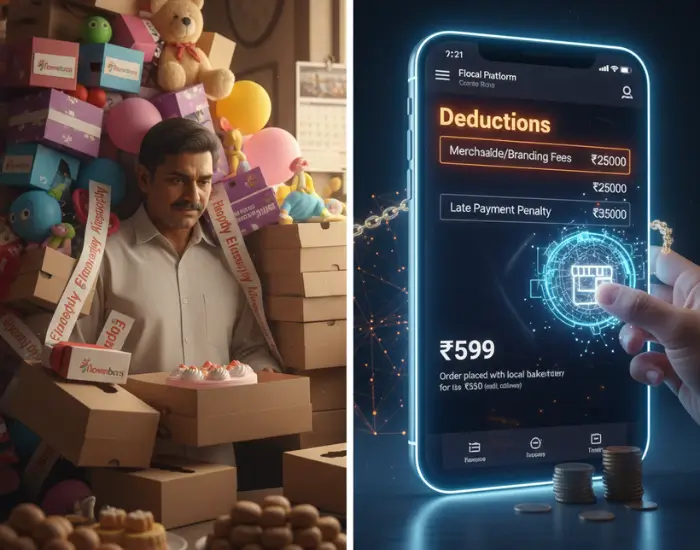
The pressure didn't stop there. Payments were often delayed for 2-3 months, and arbitrary deductions were made during payout. Local bakeries, who had already expanded their teams and were now dependent on these orders, had no choice but to accept these harsh terms. Adding to this exploitation, some platforms (like Flowerbora) developed another tactic: once a vendor's monthly billing became substantial, they would forcefully send large amounts of their own branded merchandise – like cake boxes, candles, knives, greeting cards, banners, balloons, and even teddy bears – at inflated prices, without the vendor's permission. Often, promises were made that these items would be bought back, but in reality, they remained as dead stock with the local bakery, representing a significant financial loss and a clear example of inventory dumping.
Chapter 3: The Franchise Illusion – A Path to Financial Ruin
After some time, these companies pushed local bakeries to
take up their franchises if they wanted to continue receiving orders. Franchise
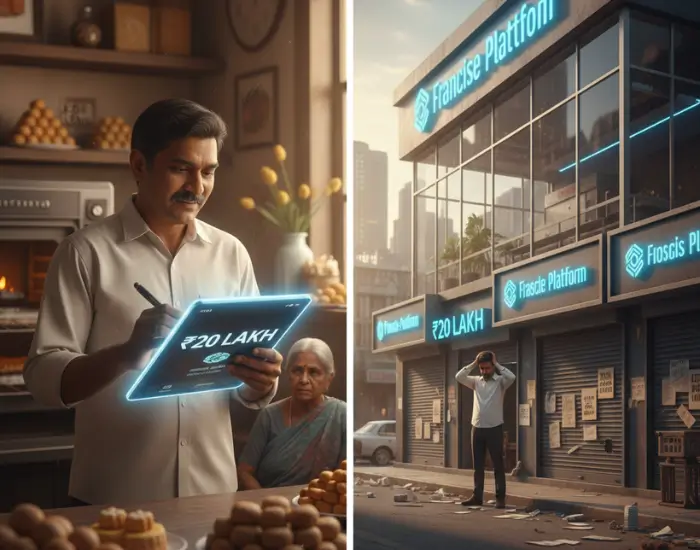
fees for companies could be as high as ₹15-₹20 lakh. Many local bakeries,
desperate to survive, mortgaged their homes or took bank loans to buy these
franchises.
But the trap continued. Soon, orders to these franchises
became scarce. These platforms would sell franchises to multiple people in the
same city. The franchise agreements were often only for 3 years, after which
another ₹15-₹20 lakh was demanded for renewal. And most shockingly, if a
franchise performed well and created demand in a city, the platform would open
its own local kitchen there, effectively replacing the very partners who helped
them grow. Any bakery or florist caught in this trap ended up in deep debt,
losing their life’s savings.
Chapter 4: The Delivery Aggregator Model – The New Face
of Extraction
Around 2019-20, delivery aggregators like Jomato and Cwiggy
entered the scene. Initially, they tied up with local bakeries and restaurants,
promising low commissions (5% or 10%) and weekly payouts. They offered huge
discounts (60-70%) to customers, making their apps popular.
However, after a few years, their commission jumped to
30-40%. They then pressured local businesses to pay for ads on their platforms
to get orders. Bakeries were also forced to offer discounts from their own
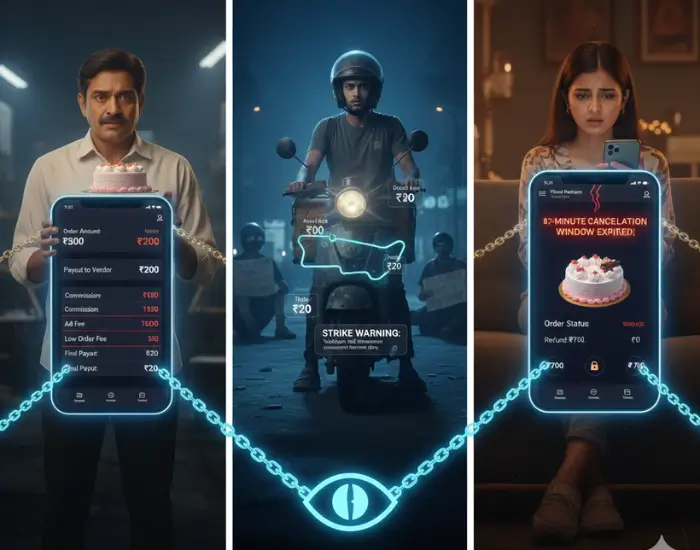
margins. For a ₹500 half-kg cake, customers might see a ₹20 delivery charge,
but in reality, the platform takes over 50% in commission and ad fees. Local
bakeries are often left with a mere ₹200-₹250. Sometimes, when orders are low,
payouts can be as little as ₹20 per cake, leading to significant losses for the
baker. This is not true technological empowerment; it's a sophisticated system
of profit extraction.
Moreover, this exploitation extends to their own delivery
partners. Initially, delivery boys were paid around ₹10 per km, along with
extra pay for picking up orders from distant restaurants or bakeries. However,
these platforms drastically cut this pay to just ₹5 per km and eliminated
pickup charges. For instance, a rider might travel 3 km for pickup and deliver
4 km, earning only ₹20 for the entire trip. When delivery partners attempted
strikes to demand fair wages, these platforms responded by terminating key
organizers and making it clear that unhappy riders could simply leave. With
India's vast population and limited job opportunities, many are forced into
these low-paying delivery jobs, and companies like Jomato shamelessly exploit
this vulnerability. The government's silence on this issue is deeply
concerning.
And their exploitation doesn't stop at businesses and
riders; customers are also significantly impacted. These platforms offer a
mere 1-minute window to cancel an order. After this brief period, if a customer
cancels, they receive no refund. The platform often retains the majority of the
amount, giving a small percentage (30-40%) to the bakery or restaurant. This
means the customer loses both the product and their money. Imagine a scenario
where a customer orders a cake for a relative, only to find out the relative is
out of town or in a different city. Or perhaps an accidental order is placed
for the wrong city. In such cases, these platforms will neither deliver the
cake nor refund the customer, effectively pocketing the entire amount while
giving a fraction to the vendor. This clearly shows that to maximize profits,
these platforms are willing to engage in ethically questionable practices, all
while the government remains a silent spectator.
Chapter 5: The Unseen Costs to Society – A Critical
Appeal to Policy Makers
This issue is far more than just a few businesses losing
money. It has deep and long-lasting consequences for our society, economy, and
future.
The GST Paradox – When Celebration Becomes a Luxury
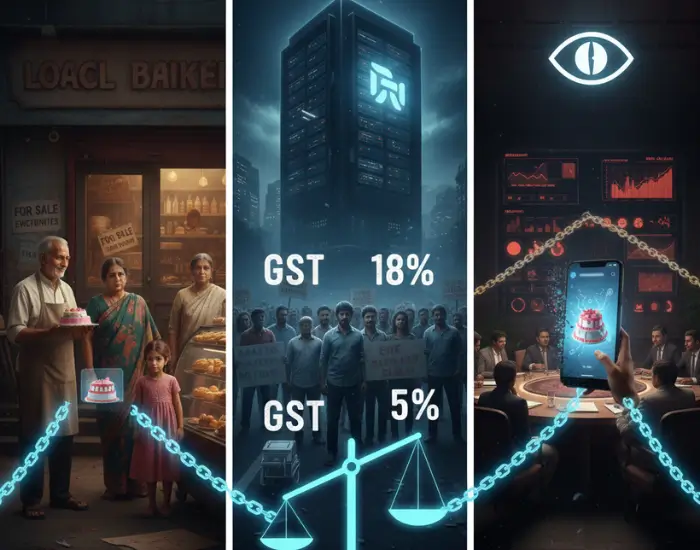
In recent years, the government classified cakes under the “luxury goods”
category, imposing 18% GST on them. The justification was simple: “Cakes are
purchased by the affluent, not the common man.”
But this statement reveals a disturbing narrative — Are
celebrations now the privilege of the rich? Walk into any Indian bakery,
and you’ll see reality.
A birthday cake isn’t a luxury item; it’s a symbol of love,
hope, and togetherness. Children from middle-class and even lower-income
families save money for weeks to buy a simple ₹100–₹150 cake. Are these
families rich?
Of course not. By treating cakes as luxury products, the
system indirectly conveys a harsh message: “Happiness is taxable.
Celebrations belong only to those who can afford them.” This policy ignores
the fact that cakes are not produced in five-star hotels alone.
They are crafted:
- In
small neighbourhood bakeries
- By
self-employed home bakers
- By
artisans who often earn less than minimum wage
- By
youth who see baking as a path to dignity, not wealth
Cake Artist's Journey: Stress to Creativity
Taxing cakes at the same rate as luxury goods is not fair
economics — it is social segregation disguised as taxation. If a government
truly believes that only the wealthy celebrate, then it fails to understand the
emotional economy of India, where:
- a
₹120 pineapple cake lights up a child’s birthday,
- a
₹200 black forest cake becomes a farewell memory,
- a
₹300 vanilla cake carries the joy of an entire family.
Celebration is not a luxury. It is culture. It is
emotion. It is Indian.
And no nation should tax joy as if it were a crime. If
happiness becomes expensive, society becomes silent.
When local bakeries, kirana shops, and restaurants close
down, millions of families dependent on them lose their livelihoods. Our
government, which already struggles to create new jobs, is unknowingly allowing
existing jobs to be destroyed. If a few large corporations control all
businesses, market competition will vanish, and product quality will decline.
Platforms are already forcing local bakeries to use cheaper ingredients,
directly compromising customer health and safety.
The most concerning aspect is the potential for increased
social unrest and crime rates when large numbers of people lose their income
and livelihood. It is crucial for policymakers to understand that this is not
just a "business" problem; it's a question of "social
stability." If we ignore these seemingly small issues today, their
consequences could affect every segment of our society tomorrow, including
those in power and their families.
Chapter 6: The Solution – Empowering Local Businesses to Fight Back
Despite these challenges, local businesses have the power to
change their destiny. Instead of giving up, we need to understand the
weaknesses of these online giants and leverage our own strengths.
Understanding the Enemy:
- Online
Cake Portals: Their weakness lies in product cost, quality, and the
inability to deliver cakes with the same freshness as a local bakery. They
rely heavily on Google Ads and SEO, making profits from high commissions
and franchise fees.
- Delivery
Aggregators: Their biggest weakness is a limited range of designs,
lack of fresh and high-quality cakes, and frequent delivery damages that
spoil customer celebrations.
Our Strengths as Local Bakeries:
- Premium
Quality & Freshness: We can offer the best, freshest cakes.
- Custom
Designs: We can create any design, offering a personal touch. (To learn more about how colors can transform your cake designs, check out our blog:
The Power of Colours in Cake Design - Local
Presence & Personal Touch: We build relationships, something
platforms cannot replicate.
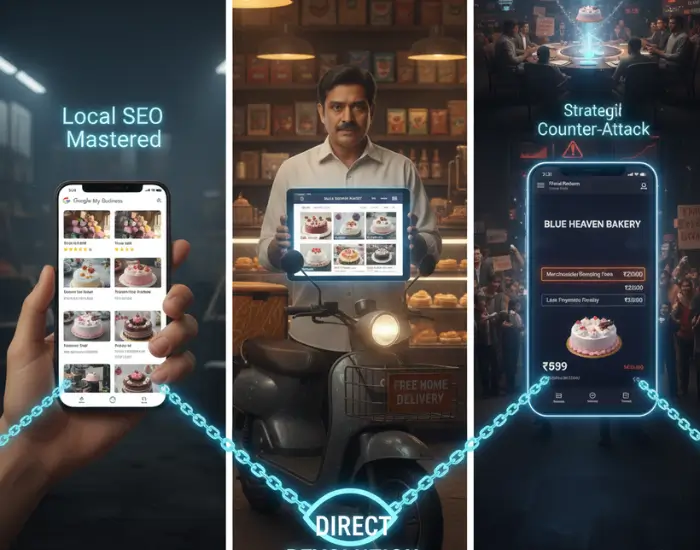
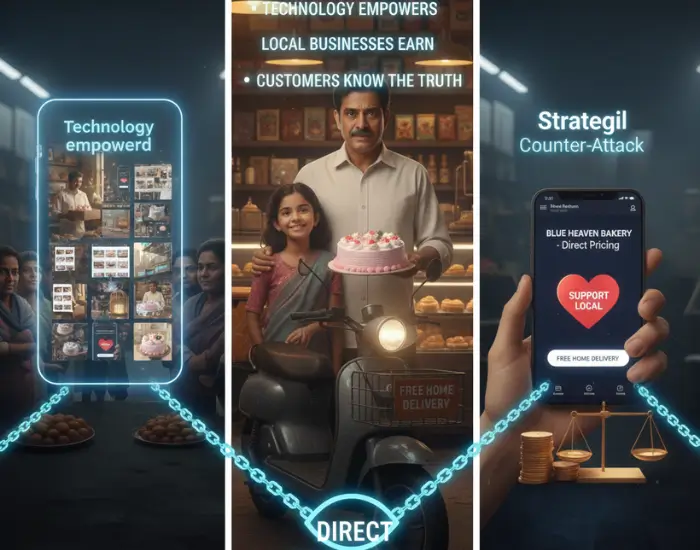
The Path Forward – Your Direct Pricing Revolution:
Here’s a practical solution, inspired by businesses like Blue Heaven:
- Build
Your Own Online Presence: Create your own professional website.
Display a wide variety of cakes, including those popular designs found on
online platforms.
- Offer
Fair Pricing: Sell these cakes at their actual cost, adding only a
reasonable margin. For example, if a platform sells a cake for ₹550-₹600,
offer the same high-quality cake for ₹350-₹400.
- Provide
Exceptional Service: Offer free home delivery and ensure 100%
safe and timely delivery. This builds immense trust.
- Optimize
Delivery Costs: Consider investing in electric bikes or scooters for
deliveries. This significantly reduces fuel expenses, allowing for very
low-cost and efficient order fulfillment, which directly boosts your
profits.
- Master
Local SEO:
- List
your business on Google My Business (GMB).
- Regularly
post high-quality photos of your cakes on GMB.
- Share
offers and updates on GMB.
- Run
targeted area-wise or city-wise Google Ads for keywords like online cake delivery in Bhopal or cake shop in Bhopal.
- Strategic
Digital Counter-Attack:
o Unite and Conquer Online: Imagine if thousands of local bakeries, every morning, collectively searched for competitive keywords like online cake delivery in Bhopal (your city), cake delivery in Bhopal (your city), or cake shop in Bhopal (your city).
o Click on Their Ads: When you see ads from these large online companies, simply click on them. Make this a part of your daily routine.
o
The Impact: Each click costs these
companies money. If millions of clicks come from competitors, their advertising
budget will drain significantly, weakening their online presence and market
reach. This collective digital action can inflict a huge financial blow, directly
impacting their dominance.
By taking these steps, local bakeries can not only survive but thrive. We can regain control of our businesses, offer better value and service to our customers, and ultimately challenge the dominance of these large companies. Middlemen are optional; trust is not.
Epilogue: The Future We Deserve – A Call for Responsible Growth
India does not lack talent. It lacks systems that truly
respect creators. If we want real progress:
- Technology
should empower, not extract.
- Local
businesses should earn, not merely survive.
- Customers
should know the truth, not merely assume.
There is nothing wrong with ordering online. The problem
begins when the system hides the truth and exploits small businesses for
one-sided gains. The world deserves convenience. Local businesses deserve
dignity. And every Indian deserves to know: A cake is not just a dessert — It
is someone’s livelihood, someone’s art, someone’s story. No platform has the
right to take more from it than the person who creates it.
This is not a complaint. This is a mirror. And now, the reflection is visible.
Related Products


3 Comment(s)
Thanks for finally writing about >The Vendor Trap: Online Food Platforms Hurting Local Businesses <Liked it!
You'll Never Guess This Louisiana Asbestos Legal Counsel's Tricks Louisiana Asbestos Legal Counsel
14 Misconceptions Commonly Held About Fast Goethe B1 Certificate B1 Goethe PrüFung Online Kaufen
Share Your Thoughts